How to Talk About Your Offer Without Sounding Salesy
You can be perfectly comfortable talking about coaching.
You can talk about confidence, mindset, limiting beliefs, habits, NLP, hypnotherapy or personal development all day long.
But learning how to sell coaching without being salesy can feel like a completely different challenge.
The moment somebody asks:
“So, how do you actually help people?”
you start overthinking it.
How much should you say?
Are you talking about yourself too much?
Do you sound pushy?
Should you explain your qualifications, your methods, your programme, your price?
And suddenly, what was a perfectly natural conversation starts to feel like a sales pitch.
The problem isn’t that you need to become better at “selling”.
You need to become more comfortable explaining how you can help.
And there is a big difference between the two.
Talking About Your Offer Isn't the Same as Being Salesy
A lot of coaches have a difficult relationship with the word sales.
They associate it with pressure.
Persuasion.
Convincing people.
Talking somebody into buying something they don't really want.
If that is what selling means in your head, it makes perfect sense that you would want to avoid doing it.
But that isn't what a good sales conversation needs to look like.
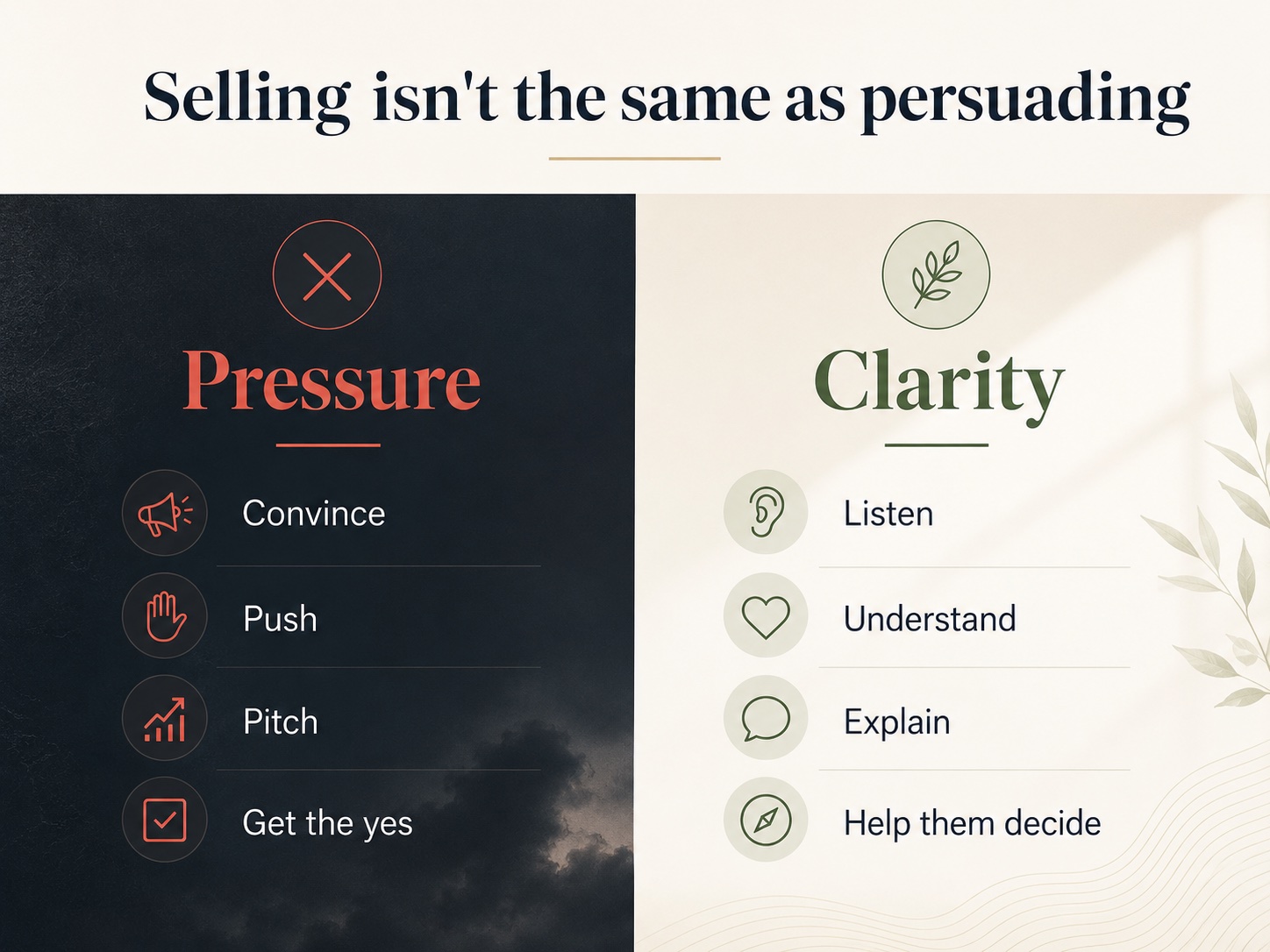
Your job isn't to convince everybody you speak to that they should work with you.
Your job is to help the right person understand:
what you help with
whether their situation is something you can help with
what working together could look like
what the next step would be
Then they can make a decision.
That's very different from putting somebody under pressure.
In fact, if someone is sitting in front of you explaining a problem you genuinely know how to help with, saying nothing about your offer doesn't necessarily make the conversation more helpful.
Sometimes the most useful thing you can say is:
“Based on what you've told me, I think this is something I could help you with.”
That's not pushy.
That's clear.
Why Does Talking About Your Coaching Offer Feel So Awkward?
Part of the problem is that many new coaches change personality the moment they think a conversation has become a sales conversation.
Up until that point, they are relaxed.
They listen.
They ask questions.
They are curious.
They are focused on the other person.
Then they realise:
“Oh. I probably need to tell them about my coaching now.”
And everything changes.
The relaxed conversation turns into an internal performance.
What should I say?
Should I mention the price?
Should I explain my qualifications?
Am I talking too much?
Do they think I'm trying to sell to them?
That is often where the awkwardness comes from.
You're no longer having a conversation.
You're trying to get the conversation “right”.
And the more you try to sound professional or persuasive, the less natural it can feel.
Stop Trying to Explain Everything You Know
One of the easiest places to hide when you feel uncomfortable talking about your offer is behind your qualifications.
For example:
“I'm an NLP Practitioner, hypnotherapist and mindset coach and I use a combination of different modalities depending on the client's presenting issue.”
There is nothing necessarily wrong with any of that.
But think about the person listening.
They may have absolutely no idea what half of those words mean.
More importantly, they probably aren't sitting there thinking:
“I really hope I can find somebody who uses three different modalities.”
They are thinking about their problem.
Maybe they are constantly doubting themselves.
Maybe anxiety is stopping them doing things they want to do.
Maybe they keep falling back into the same patterns.
Maybe their confidence has disappeared.
Maybe they know something needs to change but don't know where to start.
That is where your explanation should begin.
You could say:
“I help people who feel stuck in patterns of thinking or behaviour they haven't been able to change on their own.”
That gives the other person something they can immediately relate to.
You can explain your methods later.
First, help them understand where they fit into what you do.
If you're still struggling to do that, it may be worth going back a stage and getting clearer on [what you're actually selling as a coach].
Because sometimes what looks like a sales-confidence problem is actually an offer-clarity problem.
A Simple Way to Explain Your Coaching Offer
You don't need a perfect elevator pitch.
And you don't need a script that you recite word for word every time somebody asks what you do.
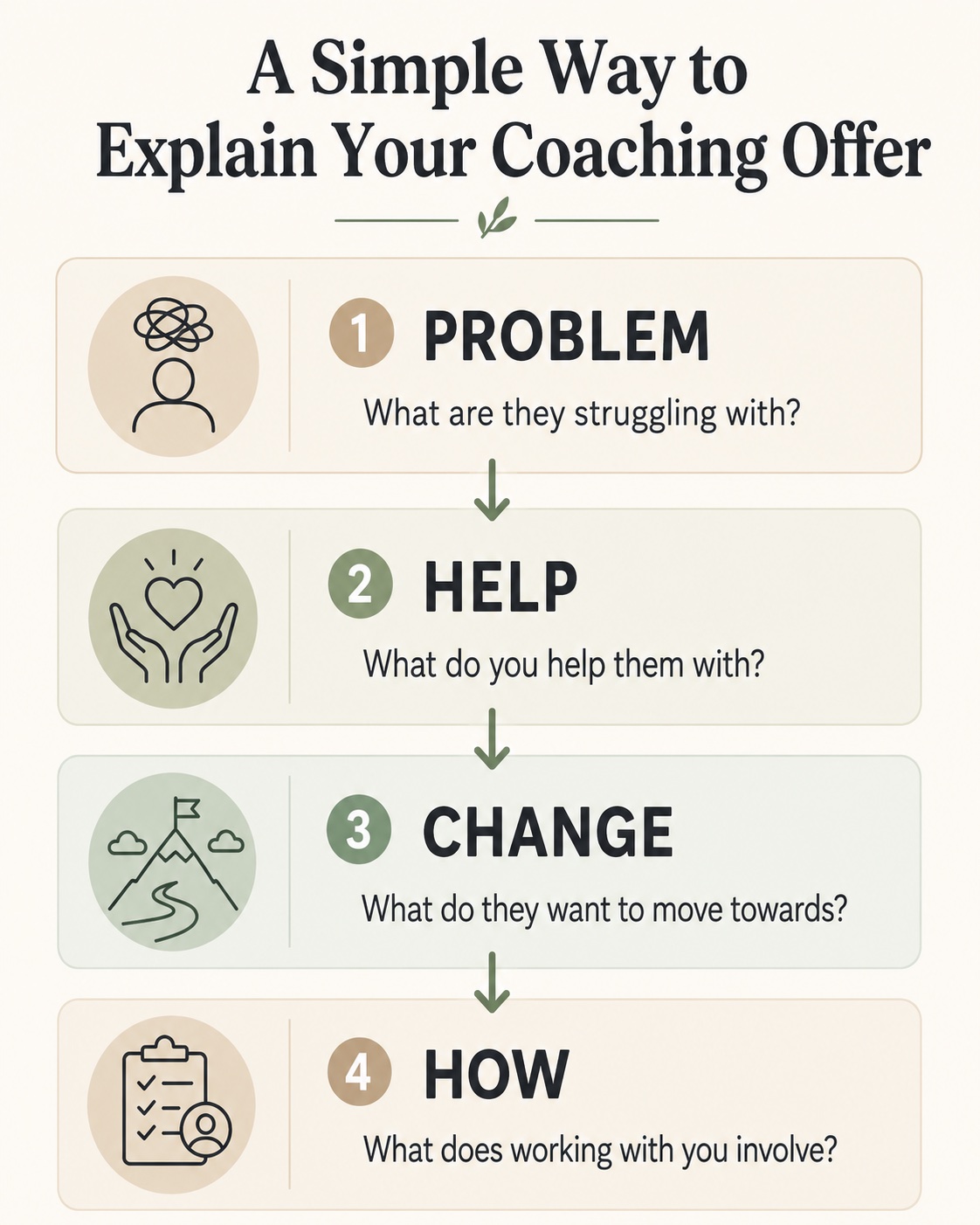
It is much more useful to understand four simple things:
Problem → Help → Change → How
1. Problem
What is happening for the person before they work with you?
What are they struggling with?
What keeps getting in the way?
2. Help
What do you actually help them with?
Not every technique you know.
Just the thing you help them work through.
3. Change
What are they hoping to move towards?
More confidence?
Less anxiety?
Better boundaries?
Feeling more in control?
Taking action?
Making a decision?
4. How
What does working with you broadly involve?
You don't need to explain every session at this point.
Give them enough information to understand what the process looks like.
Put those together and you might say something like:
“A lot of the people I work with know what they want to change, but they keep finding themselves falling back into the same patterns. I help them understand what's getting in the way and work through those patterns so they can start moving forward with more confidence. We normally do that through coaching and the techniques I'm trained in, depending on what is going on for them.”
No hype.
No pressure.
No ridiculous promise.
You're simply explaining what you do.
Use Their Words Instead of Launching Into Your Pitch
This is where talking about your offer becomes much easier.
Don't wait for your turn to deliver your standard explanation.
Listen to what the person has already told you.
Then connect your offer to their situation.
Imagine somebody says:
“I know I should be putting myself forward more at work, but whenever I get the opportunity I convince myself I'm not ready.”
A generic response might be:
“I offer six-week confidence coaching programmes using NLP and mindset techniques.”
It isn't wrong.
But it feels disconnected from what they have just told you.
A more natural response could be:
“What you've just described around knowing what you want to do but then talking yourself out of it is exactly the sort of thing I help people work through.”
Now the person understands the relevance.
You haven't forced your service into the conversation.
You have connected what you do to a problem they have already told you they want to solve.
That's why good sales conversations don't need to feel like pitches.
The conversation itself gives you most of the information you need.
It's OK to Recommend Your Own Service
This is another area where coaches sometimes tie themselves in knots.
They will happily recommend:
a book
a podcast
somebody else's course
another practitioner
an exercise
a technique
But suggesting their own service suddenly feels uncomfortable.
Why?
If you genuinely believe you can help with the problem the person has described, it is perfectly reasonable to say so.
You can say:
“Based on what you've told me, I do think this is something I could help you with.”
Or:
“It sounds like the type of issue I regularly work with.”
Or:
“I think the programme I offer could be a good fit for what you've described. Would it help if I explained how it works?”
Notice that last question.
Would it help if I explained how it works?
You've asked permission to continue.
The person still has control of the conversation.
There is no pressure.
But you haven't hidden either.
That balance matters.
Confidence Does Not Mean Pressure
Sometimes new coaches think that softening everything makes them sound less salesy.
It usually does the opposite.
You end up with something like:
“I've got a coaching programme if you're interested, but obviously there's no pressure at all and you don't have to decide anything and it's completely up to you…”
You may think that sounds reassuring.
But it can actually communicate uncertainty.
A calmer version would be:
“Based on what you've told me, I think my coaching programme could help. Would you like me to talk you through what it involves?”
That is more confident.
But it isn't more aggressive.
Being clear is not the same as being pushy.
You can be confident and relaxed.
Explain the Offer, Then Stop Talking
This sounds ridiculously simple.
But it can make a huge difference.
When coaches feel nervous about selling, they often start filling every silence.
They explain the programme.
Then the number of sessions.
Then every technique.
Then their qualifications.
Then why they became a coach.
Then a testimonial.
Then a bonus.
Then the payment options.
Then another testimonial.
Meanwhile, the other person hasn't had a chance to say anything. 😂
You don't need to fill the silence.
Explain enough for them to understand.
Then stop.
Let them think.
Let them ask questions.
Let them tell you what they are unsure about.
Let them decide what they need to know next.
Silence doesn't necessarily mean they aren't interested.
Sometimes it just means they are thinking.
And that's allowed.
You Don't Need to Have the Perfect Words
There's another trap worth avoiding.
Don't spend weeks trying to create the one perfect sentence that explains everything you do.
You may have seen advice telling you that you need the perfect:
“I help X achieve Y without Z”
statement.
Those formulas can be useful for getting your thinking clear.
But real conversations aren't formulas.
Different people will ask different questions.
Different situations will need different explanations.
Your goal isn't to memorise the perfect pitch.
It's to be clear enough about:
who you help
what they're struggling with
what you help them change
how you work
that you can explain those things naturally.
That sounds much more like you.
And that is usually far more convincing than a polished script.
If discovery calls themselves still make you nervous, you may also find [What to Say on a Discovery Call as a New Coach] useful. It gives you a simple structure for the wider conversation so you don't feel like you're making it up as you go along.
Your Job Is to Help Them Make a Decision
This is one of the biggest mindset shifts you can make around sales.
Your job isn't:
Get them to buy.
Your job is:
Help them decide.
Sometimes the right decision will be:
Yes, I'd like to work with you.
Sometimes it will be:
Not now.
Sometimes it might even be:
You're not the right person for me.
That's OK.
A good sales conversation doesn't need somebody to say yes for it to have been a good conversation.
If you have listened properly, explained clearly and helped the person understand their options, you have done your job.
Ironically, taking away the pressure to “close the sale” usually makes it easier to have better sales conversations.
You can concentrate on the person instead of constantly wondering whether you are saying the right thing.
You Don't Need to Become a Salesperson
Or at least, not the version of a salesperson you may have in your head.
You don't need tricks.
You don't need pressure.
You don't need a clever script.
And you definitely don't need to become somebody you're not.
You need to understand your offer well enough to explain it clearly.
Listen to what the other person is telling you.
Connect what you do to the problem they have described.
Explain how you might be able to help.
And then give them space to make a decision.
That's selling.
Just without all the nonsense that made you uncomfortable with the word in the first place.
And the more often you have these conversations, the more natural they become.
If you currently find yourself freezing, over-explaining or avoiding talking about your offer completely, don't assume you're simply “bad at sales”.
It may just mean you need a clearer message and a bit more practice using it.
And that is something you can learn.
Want to Feel More Comfortable Talking About What You Offer?
Knowing what to say is one thing.
Feeling comfortable saying it is another.
If you'd like some help getting clearer on your offer, explaining the value of what you do and becoming more confident in sales conversations without turning into somebody you're not, that's exactly the kind of thing I help coaches work through.
You don't need a pushier sales technique.
You need a way of talking about what you do that feels natural, clear and like you.
Find out more about how I can help you improve your sales confidence and client conversations.